
Marriage is one of the most meaningful steps in a Muslim’s life. In Pakistan, that sacred commitment can now be completed conveniently through a lawful Online Nikah. Couples living in Karachi, Lahore, Islamabad, Rawalpindi, Faisalabad, Multan, Peshawar or Quetta—and even abroad—can marry from wherever they are, while remaining within both Islamic and Pakistani legal boundaries.
PakistanMarriage.com.pk provides complete Online Nikah and Court Marriage services. Every Nikah is supervised by qualified Nikah Khawans and family law professionals who prepare the documents, conduct the live ceremony, and handle Union-Council registration, so couples begin their new life with peace of mind.
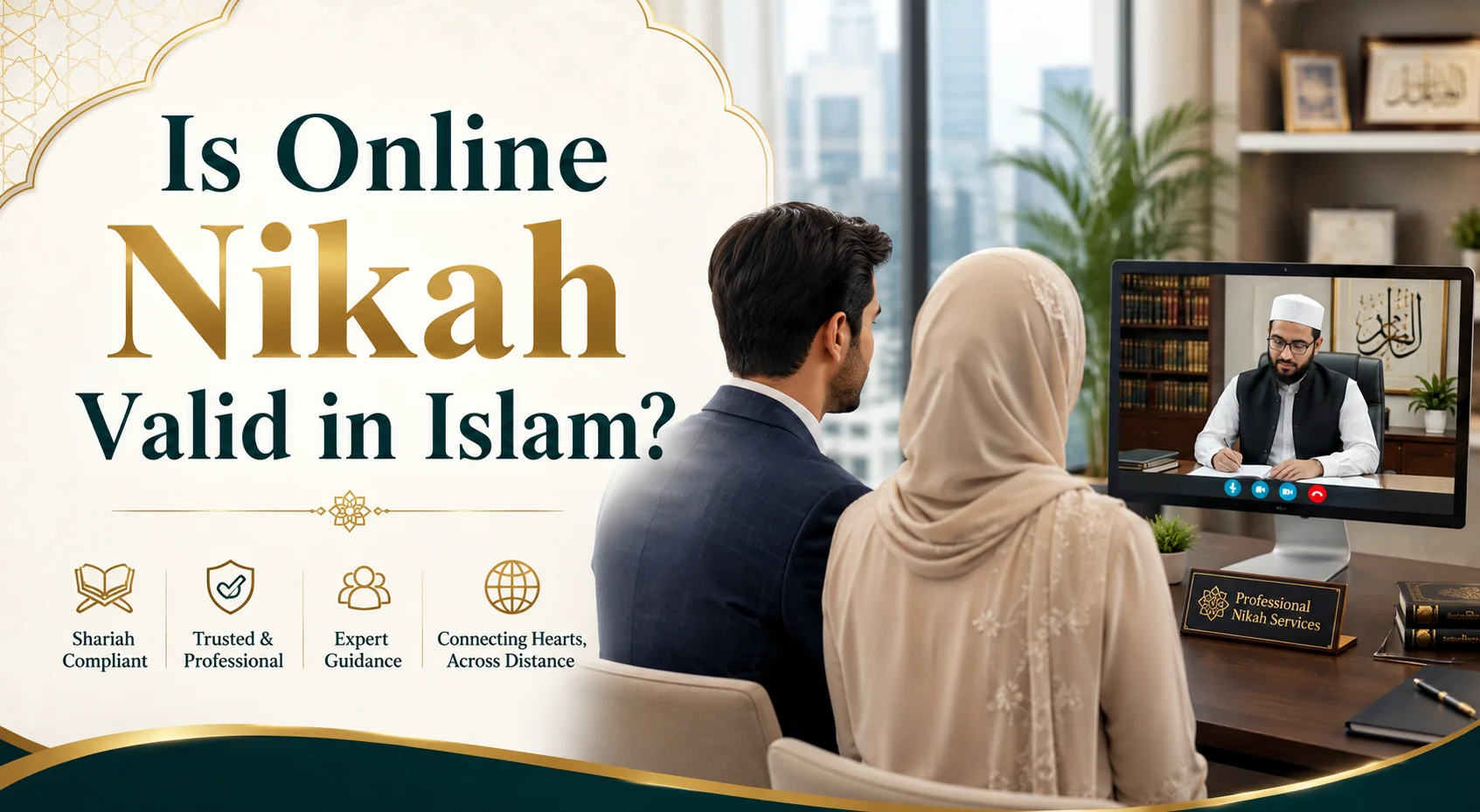
An Online Nikah is a marriage solemnised through a secure video connection—often via WhatsApp, Zoom, or Google Meet—where the essential Islamic and legal conditions are observed. The Nikah Khawaan oversees the Ijab-o-Qabool (offer and acceptance), records witness testimony, and notes the Mehr.
Couples often choose this method when distance or travel restrictions make an in-person ceremony difficult. Once the Nikah is performed and registered at the Union Council, it becomes fully valid under Pakistani law.
Islam views marriage as a divine sign of mercy and companionship. The Qur’an reminds believers:
“And among His signs is that He created for you spouses from among yourselves so that you may find tranquillity in them, and He placed between you love and mercy.” (Surah Ar-Rum 30:21)
A Nikah is valid when four elements exist: the Ijab and Qabool, two adult witnesses, a defined Mehr, and mutual consent. Islam does not restrict the medium of communication, so an Online Nikah that fulfils these requirements carries full Sharia status.

+92316-6644789
+92302-6644789
+92333-2316871
Any Muslim man or woman of sound mind and legal age may marry through this process. Pakistani courts, including the Supreme Court in PLD 2004 SC 219, have ruled that an adult Muslim woman can marry of her own free will, even without her guardian’s approval.
Our platform assists:
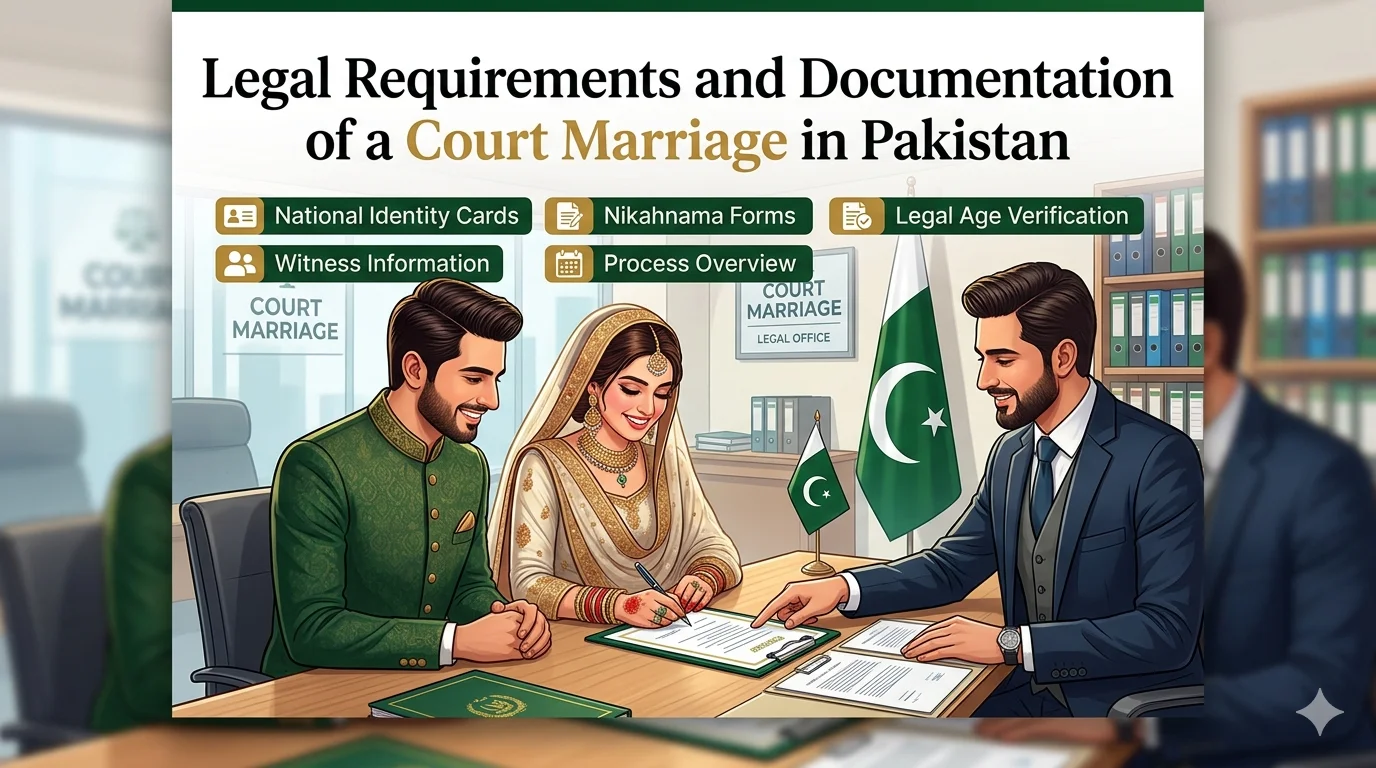
Both types of marriage are lawful; the difference lies mainly in location and paperwork. A Court Marriage takes place before a registrar or magistrate, while an Online Nikah is performed live over video under the supervision of an authorised Nikah Khawaan.
Aspect | Court Marriage | Online Nikah |
Venue | Registrar’s office | Live video link |
Witnesses | Physically present | Online or represented by Power of Attorney |
Documentation | Signed on paper | Signed digitally and registered |
Legal Effect | Fully binding | Equally binding |
An Online Nikah becomes legally effective once registered at the Union Council in accordance with the Muslim Family Laws Ordinance, 1961. The couple receives a manual certificate, followed by a computerised NADRA Marriage Certificate, recognised for all civil and immigration purposes.
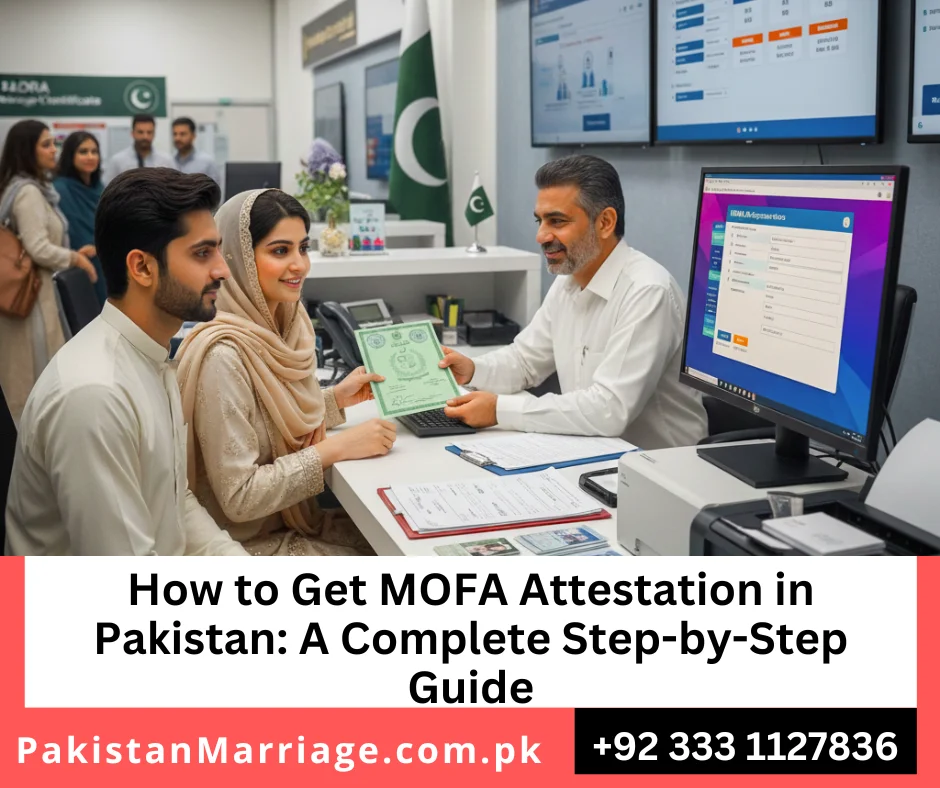
After attestation by the Ministry of Foreign Affairs (MOFA) and the relevant embassy, the marriage certificate is accepted internationally, including in the UK, USA, Canada, UAE and Saudi Arabia.
In most cases, the complete process concludes within a single working day once all papers are ready.


All information remains strictly confidential and handled by licensed professionals.
In Pakistan, the presence of a wali is not compulsory for an adult woman’s marriage. The Lahore High Court (PLD 1997 Lah 301) and Supreme Court (PLD 2004 SC 219) confirmed that a sui juris woman may enter Nikah independently. During Online Nikah, her free consent is recorded both in writing and on video to safeguard her rights under Islamic and civil law.
The Nikahnama serves as the formal marriage contract. It records the parties’ details, the Mehr, any delegated Talaq-e-Tafweez, and witness signatures. Once signed, it is submitted to the Union Council for registration, after which the NADRA Marriage Certificate is issued. Both Urdu and English formats are available for local and international use.
Thousands of Pakistanis living in the Gulf, the United Kingdom, the United States and Canada choose this method every year. It allows them to marry lawfully without travelling to Pakistan. Our team prepares the documents, conducts the live Nikah, registers the marriage and manages attestation from MOFA and the relevant embassy. Certified copies are couriered to the couple’s address worldwide.
Once a Nikah is registered, the Union Council issues its manual record, which NADRA then converts into a computerised certificate. This document is Pakistan’s official proof of marriage and is required for:
A Shariat Nikah fulfils the religious command of marriage but carries no civil status until it is formally registered. Many couples begin with the Shariat Nikah for spiritual satisfaction and then proceed with legal registration to protect both partners’ rights.
At PakistanMarriage.com.pk, both ceremonies can be arranged together—one focused on faith, the other on legal recognition.
Under the Child Marriage Restraint Act of 1929, both bride and groom must be at least 18 years old. Before every Nikah, our office verifies age and identity through CNICs or passports. This step protects couples from later objections and ensures compliance with Pakistani family law standards.
Couples in major Pakistani cities and abroad increasingly choose Online Nikah because it is:

Every Online Nikah conducted through PakistanMarriage.com.pk is performed strictly in accordance with Pakistan’s marriage laws and Islamic jurisprudence. The procedure combines the religious requirements of Nikah with the civil obligations set out in local statutes, ensuring that each marriage is both spiritually and legally sound.
Several landmark judgments affirm the validity of marriages performed with consent and proper documentation:
Together, these provisions and precedents leave no ambiguity: an Online Nikah, once registered, holds the same legal status as any marriage conducted face-to-face.
In practice, Online Nikah has become a preferred choice among young professionals, overseas students, and expatriate Pakistanis who want their marriage recognised in both religious and legal terms. The following examples illustrate how the process works in everyday situations.
Karachi and Lahore Clients
Couples living in different cities—often one in Karachi and the other in Lahore—frequently use Online Nikah to avoid long travel and family-court scheduling. Our Nikah Khawans coordinate timings, verify documents through video call, and register the marriage with the respective Union Council within hours.
Overseas Pakistanis in the Gulf
Many Pakistani residents in Dubai, Doha, and Riyadh prefer Online Nikah because local laws in those countries restrict Muslim marriages for non-citizens. By marrying under Pakistani jurisdiction, they receive a NADRA Marriage Certificate that can later be used for spouse visas and family-residency applications.
Students and Professionals Abroad
Pakistani students in the United Kingdom, Canada, and Australia often face visa and scheduling limitations. With Online Nikah, they can solemnise the marriage remotely, then have their documents attested at the Pakistani Embassy or High Commission in their host country. The entire process follows the same standards applied by registrars in Pakistan.

Practical Advice for Clients
By following these steps, couples protect their rights and prevent future disputes. Our legal advisers remain available throughout the process to explain each stage and to coordinate between Pakistani authorities and foreign embassies when required.
Every Nikah is treated individually, with clear communication and full adherence to Islamic and Pakistani legal procedures.
Is Online Nikah valid under Pakistani law?
Yes. Once registered through the Union Council, it carries the same legal standing as a marriage performed in person.
Can it be recognised abroad?
Yes. After attestation by the Ministry of Foreign Affairs and the relevant embassy, your certificate is accepted worldwide.
Can a woman marry without a wali?
Yes. Pakistani courts, including the Supreme Court (PLD 2004 SC 219), affirm that an adult Muslim woman may marry of her own free will.
How long does the process take?
Normally a few hours after all papers are verified.
Will NADRA issue a certificate?
Yes. A computerised NADRA Marriage Certificate is issued after Union-Council registration.
Can witnesses be arranged?
Yes. Our offices can provide witnesses if the couple cannot arrange their own.
Is Online Nikah recognised for immigration?
Yes. Properly attested Pakistani marriage documents are accepted by immigration authorities worldwide.
Do you offer both Urdu and English Nikahnamas?
Yes. The contract is available in both languages to meet Pakistani and international requirements.
Is the process Sharia-compliant?
Absolutely. Each step follows Islamic principles and Pakistani family law.
What if one partner is overseas?
We conduct the Nikah via video link with a Power of Attorney representing the absent partner; the process remains fully legal.
Marriage marks the start of a new chapter blessed by faith and recognised by law.
If you wish to solemnise your Nikah online—quickly, privately and in full accordance with Islamic and Pakistani legal requirements—contact PakistanMarriage.com.pk.
Our legal and religious teams will guide you from the first consultation to the delivery of your NADRA Marriage Certificate.
Start your new life with assurance and ease: speak with our Online Nikah lawyers today for a confidential discussion.
Pakistan Marriage Services provides legal assistance for Court Marriage, Online Nikah, and marriage registration across Pakistan under the legal supervision of Zaheer Ahmed Qazi (Advocate High Court) and the management of Advocate Sobia Mohsin, Family Lawyer.
Karachi Head Office: Qanoon House, Johar Chowrangi, Gulistan-e-Johar, Karachi, Pakistan
Court Marriage | Online Nikah | Nikah Nama | NADRA Marriage Certificate