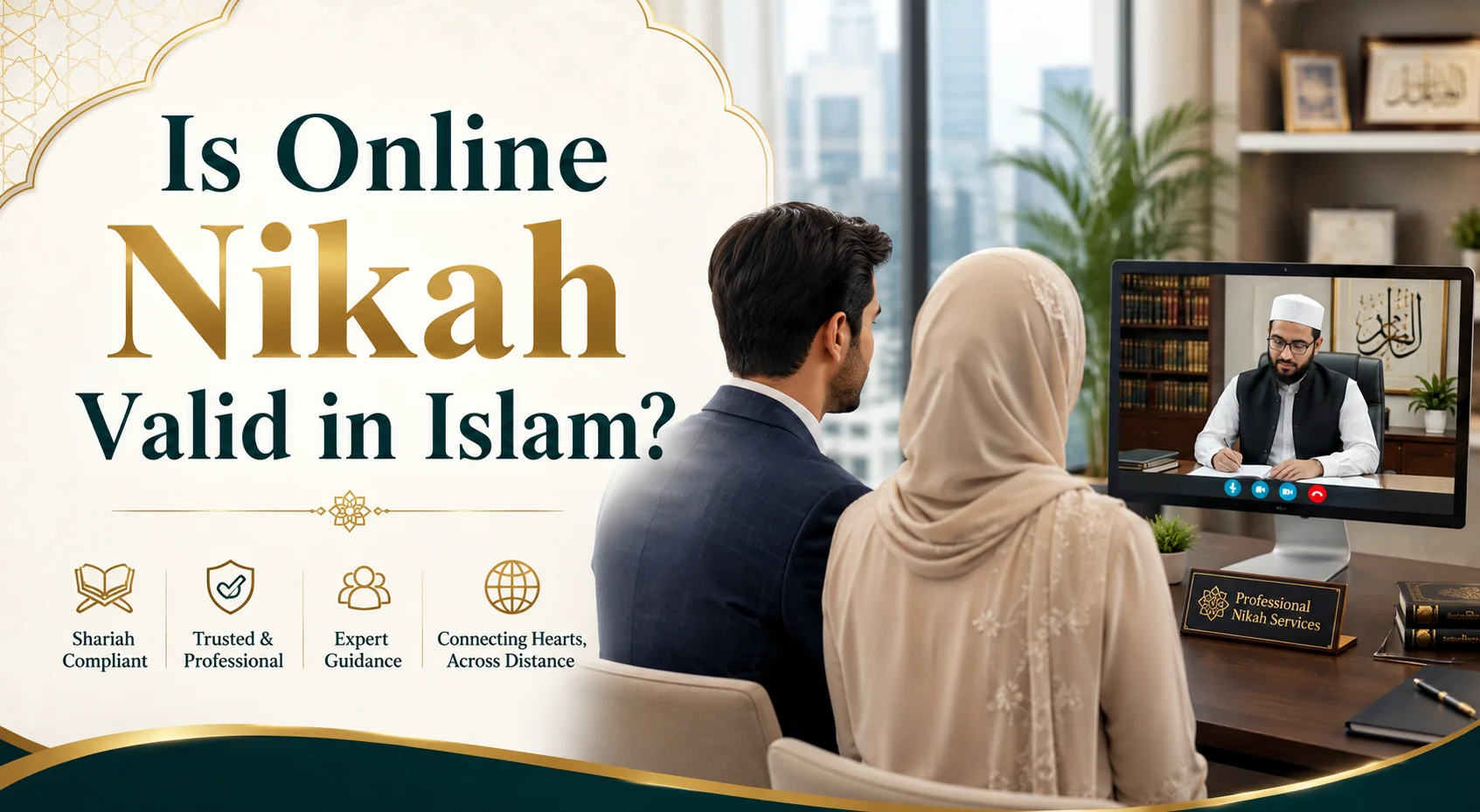

Court Marriage in Pakistan is a lawful, secure, and practical way for two eligible adults to solemnize their marriage with free consent under Pakistani law. At Pakistan Marriage Services, our senior family lawyers and legal team assist couples with court marriage documentation, lawful Nikah solemnization, registration procedures, and guidance on marriage records across Karachi, Lahore, Islamabad, and Rawalpindi.
With decades of practical experience in Pakistani family law matters, our legal team helps ensure that every court marriage is conducted in a private, legal, and properly documented manner.

Court marriage in Pakistan is a legally recognized marriage process through which two adults may marry of their free will and lawful consent. The marriage is solemnized in accordance with Islamic requirements and Pakistani family law procedures, and the resulting documents are then registered through the authorized legal process.
The rules for court marriage in Pakistan primarily address age, free consent, legal capacity, identity verification, witnesses, Nikah solemnization, and marriage registration. Once these legal requirements are fulfilled, the marriage enjoys full legal status, and the spouses receive all rights available under Pakistani family law.
Many couples choose court marriage in Pakistan because it offers a lawful, efficient path to marriage without unnecessary delay, pressure, or confusion. It is especially preferred by couples who want privacy, quick legal processing, and proper marriage documentation for future personal and legal use.
Court marriage is also commonly chosen in love marriages, when family resistance is a factor, when overseas documentation is required, and when couples want a simple yet fully lawful marriage process.
Court marriage in Pakistan is not an informal arrangement. It is rooted in Pakistani family law and legal procedure. The legal framework includes the following sources:
This is one of the main laws governing Muslim marriages, family rights, and marriage registration matters in Pakistan.
The Nikahnama is the formal marriage contract. It must be properly completed, signed, and processed through the lawful registration mechanism.
The marriage must be solemnized and recorded in accordance with lawful procedure so that it is recognized for family rights, inheritance, marital status, and official record purposes.
A court marriage becomes fully valid when it is lawfully solemnized and properly registered.
+92316-6644789
+92302-6644789
+92333-2316871



At Pakistan Marriage Services, court marriage guidance is not based solely on general internet information. It is based on practical legal handling, real family law experience, and long-standing work in marriage, Nikah, registration, family disputes, and related legal documentation matters.
Our legal team has practical experience in handling court marriage and family law matters for couples in major cities of Pakistan.
We understand the legal requirements of age, consent, documents, witnesses, Nikah procedure, and registration under Pakistani law.
Our content and guidance are structured around actual legal procedure, lawful marriage documentation, and practical family law standards in Pakistan.
We emphasize privacy, proper documentation, lawful process, and legally sound handling so couples can proceed with greater confidence and clarity.


To qualify for court marriage in Pakistan, both parties must meet the legal eligibility requirements.
The bride and the groom must both be at least 18 years old. Marriage below the lawful age is not permitted and may lead to legal consequences.
The marriage must be based on free will. No valid court marriage can be performed where there is coercion, threat, fraud, or forced pressure.
Each party must be mentally sound and capable of understanding the nature and consequences of marriage.
If either person was previously married, the earlier marriage must have been lawfully dissolved, or the relevant death-related record must be available where required.
The legal age requirement is one of the most important rules for court marriage in Pakistan. Both male and female must be 18 years of age. This legal requirement protects the rights of both parties and ensures that the marriage is entered into by adults who can lawfully consent.
Age verification is usually checked through CNIC or other legally acceptable identity documents. Any deficiency in age proof can delay or invalidate the marriage process.
Consent is the heart of a valid marriage. Pakistani law and proper marriage procedure require that both the bride and groom willingly agree to the marriage. The consent must be genuine and free from:
During the court marriage process, free will is generally supported through affidavits and verbal confirmation. A lawful court marriage cannot stand on forced consent.
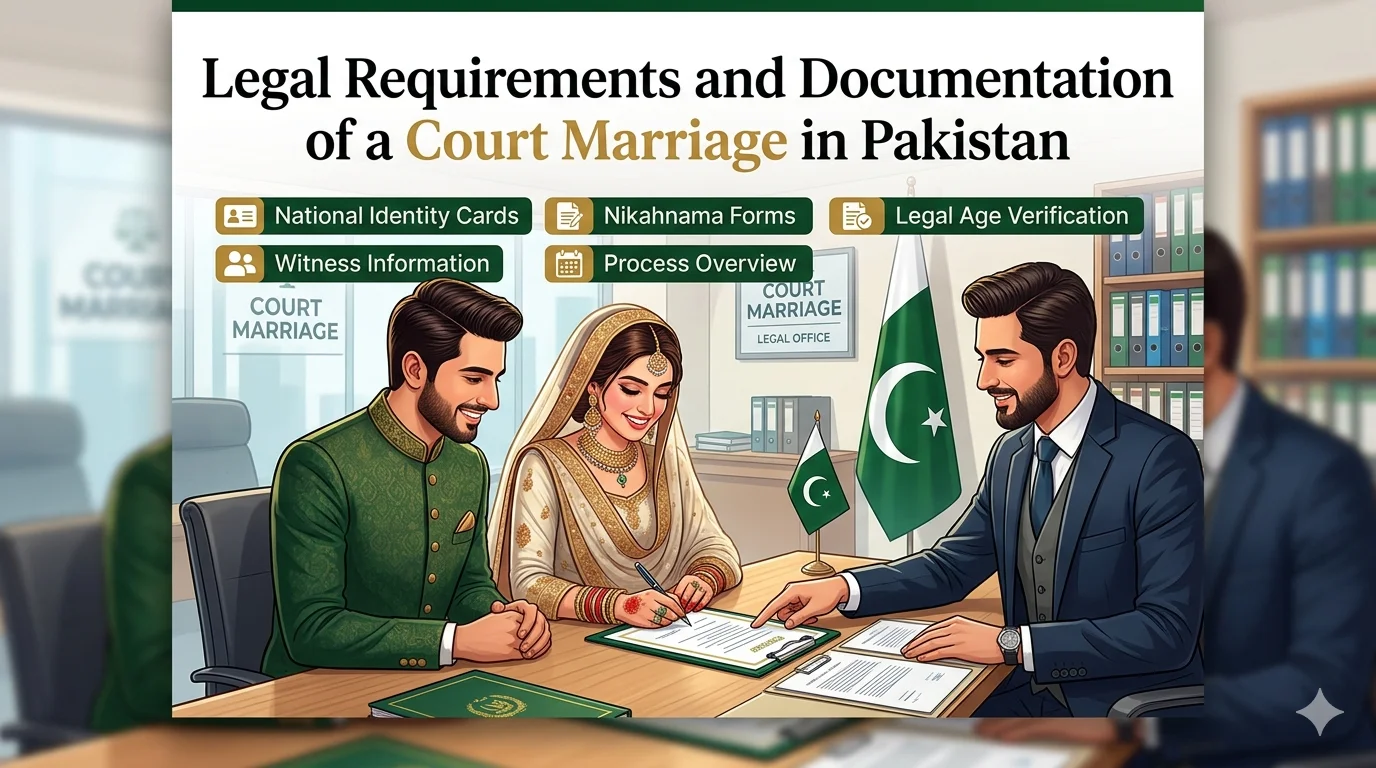
Proper documentation is essential for a valid and smooth court marriage process. Depending on the facts of the case, the required documents may vary slightly, but generally the following are needed:
Some special marriages, overseas cases, or document-sensitive matters may require additional supporting papers.
The court marriage procedure in Pakistan follows a structured legal sequence. When properly managed, the process is efficient and transparent.
The first stage is checking CNICs, photographs, previous marital status, and other relevant documents.
Affidavits are prepared to confirm consent, identity details, and any special facts necessary for the marriage process.
The Nikah is solemnized by a licensed Nikah Registrar in the presence of witnesses.
The bride, groom, witnesses, and relevant officiating authority sign the Nikahnama.
After solemnization, the marriage record is processed through the proper registration channel to ensure it is legally documented.
In a court marriage in Pakistan, the Nikah Registrar plays a central legal role by solemnizing the marriage and ensuring all legal requirements are fulfilled. The registrar verifies identities, records consent, and completes the Nikahnama. Witnesses, usually two adults, are required to observe the Nikah, confirm the consent of both parties, and sign the marriage documents to validate the process.
Marriage registration under Pakistani law is a compulsory legal requirement that gives formal recognition to the marital relationship. After the Nikah is solemnized, the Nikahnama must be properly filled, signed, and registered with the relevant Union Council or authorized authority. This registered document serves as official proof of marriage and ensures enforcement of legal rights related to inheritance, family records, and marital status under Pakistani family laws.
Court marriage in Pakistan provides a legal avenue for couples in love marriages and certain interfaith situations to solemnize their union lawfully. It ensures that the marriage is recognized under national laws, even when family consent may be absent. Through the court procedure, couples can register their marriage officially, protecting their legal rights and offering a clear framework for recognition and documentation under Pakistani law.
Witnesses and the Nikah Registrar are central to a valid court marriage in Pakistan.
At least two adult male witnesses are required to observe and verify the marriage process. Their role is not symbolic only. They confirm that the Nikah took place and that the parties entered the marriage with consent.
The Nikah Registrar performs the solemnization and ensures that the Nikahnama is properly completed. The registrar’s role is critical for lawful documentation and registration.
A court marriage does not end with solemnization alone. Marriage registration is a compulsory legal requirement. Once the marriage is properly registered, the Nikahnama becomes a formal record and serves as proof of marriage for future legal and official purposes.
This legal record is important for:
Court marriage is often used by couples who wish to marry by choice. In love marriage matters, the law protects the right of two eligible adults to marry with their consent, even if family approval is absent.
For such couples, court marriage offers:
The law recognizes valid consent, not social pressure, as the foundation of marriage.
Overseas Pakistanis can also complete court marriage in Pakistan, provided the legal documentation and verification requirements are met. Depending on the case, valid CNICs, passports, and attested papers may be required.
Where the case involves international residence or special documents, legal guidance becomes even more important so that the marriage record can later support immigration, embassy, or foreign documentation use.
If all required documents are complete and the facts are clear, court marriage in Pakistan can often be completed within one day. Delays usually happen only when documents are incomplete, identity details are inconsistent, or a special legal issue requires additional verification.
Once a court marriage is lawfully solemnized and registered, both spouses enjoy full legal rights under Pakistani family law. These rights include:
A properly registered marriage protects both spouses and reduces future disputes regarding marital status and legal entitlement.
Yes. Court marriage in Pakistan is fully legal when performed according to law. It has the same legal status as any other valid marriage. It is not a lesser form of marriage, nor is it limited to any one category of couple.
A common misconception is that court marriage is only for couples facing family opposition. In reality, it is simply a lawful, documented, and practical method of marriage recognized under Pakistani law.
Pakistan Marriage Services assists couples who want their marriage handled properly, privately, and in accordance with Pakistani law. We focus on lawful process, clear documentation, practical support, and legally sound guidance.
Whether the matter concerns a simple court marriage, a love marriage, or a documentation-sensitive case, proper legal handling makes the process more secure and reliable.
Short CTA:
For lawful guidance on court marriage in Pakistan, call our legal team in Karachi, Lahore, or Islamabad today.
Yes, court marriage is legal in Pakistan when it is solemnized and registered according to the applicable law and procedure. Once properly completed, it has full legal validity.
The minimum legal marriage age is 18 years for both male and female. Any marriage below this age is unlawful.
Usually, the bride and groom need their original CNICs or valid identity documents, photographs, witnesses’ CNIC copies, and affidavits of free will. In special cases, divorce or death-related documents may also be needed.
Yes, in many cases the process can be completed within one day if all documents are complete and there is no legal complication.
For two legally competent adults, the core legal requirement is free consent of the parties. Family approval is socially important in many cases, but the marriage itself is based on lawful consent.
Yes, overseas Pakistanis can conduct court marriage in Pakistan by fulfilling the legal documentation and verification requirements applicable to their case.
Many couples specifically want to know how much time is consumed in the actual Nikah solemnization and signing formalities. In a normal court marriage case, the Nikah solemnization, signing on the Nikahnama, and signing of the affidavits usually take only 20 to 25 minutes. This is the part that is completed quickly once the couple and witnesses are present and the documents are ready.
However, couples should understand that the official Nikah registration with the authorized Nikah Registrar normally takes one full day in routine cases. If the matter is handled on an urgent basis, the Nikah registration may often be completed within 2 to 3 hours, depending on timing, availability, and document readiness.
This clear distinction is important because many people confuse the Nikah solemnization time with the official registration time. The solemnization itself is brief, but the registration process may take longer.
You can also replace the earlier short timeline paragraph with this stronger version:
If the documents are complete and the couple is legally eligible, the Nikah solemnization, signing of the Nikahnama, and affidavit execution usually take only 20 to 25 minutes. This is the actual marriage ceremony and document-signing stage.
After that, the official Nikah registration process with the authorized Nikah Registrar normally takes one day. In urgent cases, this registration process may be completed in 2 to 3 hours, provided the documents are complete and the matter is taken up on priority basis.
If you want, I can now merge this into the full page and give you the final ready-to-paste revised version.
Pakistan Marriage Services provides legal assistance for Court Marriage, Online Nikah, and marriage registration across Pakistan under the legal supervision of Zaheer Ahmed Qazi (Advocate High Court) and the management of Advocate Sobia Mohsin, Family Lawyer.
Karachi Head Office: Qanoon House, Johar Chowrangi, Gulistan-e-Johar, Karachi, Pakistan
Court Marriage | Online Nikah | Nikah Nama | NADRA Marriage Certificate