
Last Updated: 27 September 2026
Is online Nikah valid in Islam? Yes, an online Nikah can be valid in Islam when the marriage fulfils the applicable Shar’i requirements. The internet or video connection does not itself create the Nikah; validity depends on the marriage contract, free consent, Ijab-o-Qabool, witnesses where required by the applicable school of Islamic law, Mahr, lawful capacity to marry, and valid authority where a Wakil represents an absent party.
For Pakistani and overseas families, the most important distinction is between a direct video-call Nikah and a Wakalah or proxy Nikah. Scholars have differing views on whether a purely remote video session satisfies every classical requirement of the majlis and witnessing. Wakalah, by contrast, is a long-established mechanism in Islamic jurisprudence for a party who cannot attend personally.
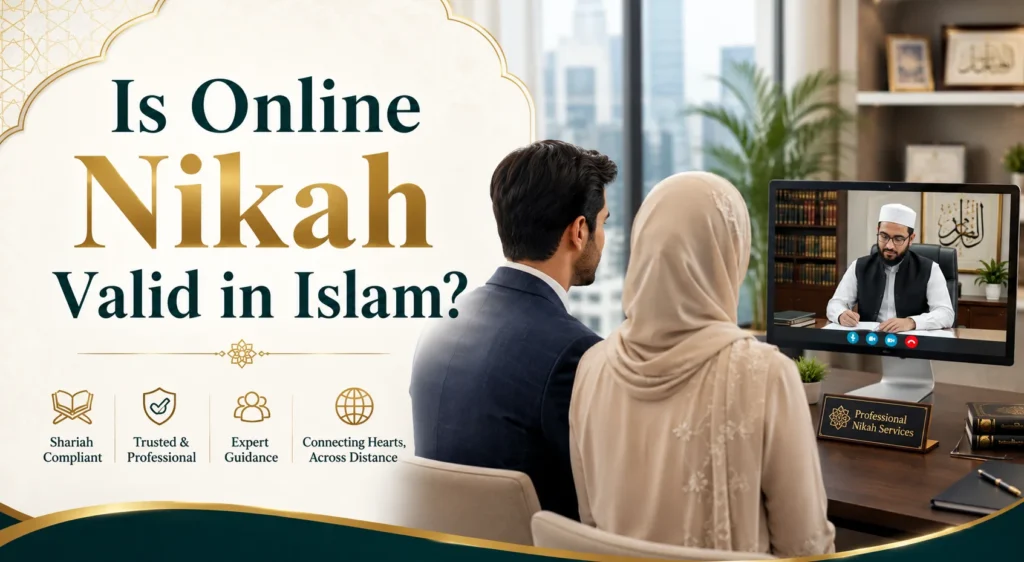
An online Nikah is not automatically valid merely because the bride, groom and witnesses appear on a live call. The correct question is whether the essential conditions of Nikah are satisfied in a manner recognised by the applicable school of Islamic law. Technology changes the means of communication; it does not change the core requirements of the marriage contract.
Where one party appoints a properly authorised Wakil, and the Wakil participates in the Nikah gathering with the required witnesses and a valid Ijab-o-Qabool, the marriage can be concluded without the absent party being physically present. This classical agency structure is the foundation of many Shari’a-compliant online Nikah arrangements.
Before asking whether an online Nikah is valid in Islam, it is useful to identify the elements that make any Muslim marriage valid. The precise details can vary between schools of Islamic jurisprudence, so a family following a particular madhhab should obtain school-specific religious guidance where necessary.
Ijab-o-Qabool means the offer and acceptance of marriage. The words must clearly relate to the same marriage, and the acceptance must correspond to the offer. In a Wakalah arrangement, a duly authorised representative may make or accept the offer on behalf of the absent party within the scope of the authority given.
Free and genuine consent is essential. Neither the bride nor the groom should be coerced. Where family opposition, distance or an overseas residence creates a risk of later dispute, it is sensible to document identity and consent carefully before the online Nikah is solemnised.
Witness requirements differ by school. In Sunni jurisprudence, witnesses are central to the Nikah, while the precise composition and conditions are treated differently by the various schools. In Hanafi practice, commonly followed in Pakistan, the witness rules should be checked and applied carefully. The witnesses must genuinely understand that a marriage contract is being concluded and must be able to identify the parties or their authorised representatives.
Mahr is the wife’s right and should be agreed and recorded clearly. It may be prompt, deferred, or partly prompt and partly deferred. The amount, currency, property or other agreed form of Mahr should not be left vague merely because the Nikah is being arranged online.
The roles of Wali and Wakil should not be confused. A Wakil is an authorised representative who acts for a party who cannot or does not personally participate in the physical gathering. The role of a Wali differs between schools of Islamic law. Under Hanafi jurisprudence, an adult and sane Muslim woman has capacity to contract her own marriage subject to the relevant rules, while other Sunni schools generally give the Wali a different role. Pakistani legal capacity and a school-specific religious opinion should therefore be distinguished.
The Wakalah method is not an invention of the internet age. Islamic law has long recognised agency where a person cannot attend personally. Modern communication simply makes identity verification, consent and coordination easier.
First, the absent bride or groom appoints a trusted Wakil and gives clear authority for the intended Nikah. Second, the Wakil attends the Nikah gathering with the required participants. Third, Ijab-o-Qabool is completed in the same connected transaction. Fourth, the witnesses hear and understand the contract. The absent party may also join by video or audio for identification and reassurance, but the legal-religious structure rests on valid representation rather than on the technology alone.
For overseas Pakistanis, Wakalah can remove uncertainty created by different time zones, travel restrictions and the physical absence of one spouse. It also creates a clearer documentary trail for later registration, embassy use, immigration applications and family records.
A direct video-call Nikah is one of the areas where contemporary scholars have expressed different views. Some scholars consider a live, uninterrupted audiovisual session capable of satisfying the requirement of a connected majlis when identities are verified and the witnesses can hear the offer and acceptance clearly. Other scholars take a more cautious view and prefer the classical Wakalah structure so that the witnesses and contracting representative are physically present in one gathering.
Because Pakistan is predominantly Hanafi, many families prefer to structure an online Nikah through Wakalah rather than depend entirely on remote witnessing. This avoids making the validity of the marriage turn on a disputed modern question about whether a digital session is equivalent to a classical physical majlis.
If a couple follows another school of Islamic jurisprudence, or has already conducted a direct video Nikah and wants to know its status, the correct approach is to obtain a ruling from a qualified scholar familiar with that school and the exact facts. A legal service provider should not present a disputed theological question as though every school gives the same answer.
Online Nikah in Islam is especially relevant for Pakistanis living in the United Kingdom, United States, UAE, Saudi Arabia, Canada, Europe, Australia and other countries. One spouse may be in Pakistan while the other is abroad, or both may be overseas but need a marriage registered in Pakistan.
A properly planned case can involve identity verification, a Wakalah or power of attorney, witnesses, a Nikah Khawan, completion of the Nikah Nama, and later registration. Families should plan the complete process before the ceremony rather than treating documentation as an afterthought.
Depending on the case, documents can include CNIC, NICOP or passport copies, photographs, proof of marital status, divorce or death documents from a previous marriage, and a Wakalah or power of attorney. Foreign documents may require notarisation, attestation or translation depending on where they will be used.
The religious validity of a Nikah and its legal registration are related but distinct questions. A Nikah may satisfy the applicable Shar’i requirements, but Pakistani law also requires Muslim marriages to be registered. Section 5 of the Muslim Family Laws Ordinance, 1961 provides the statutory registration framework for Muslim marriages.
After the Nikah is solemnised, the prescribed Nikah Nama should be completed accurately and processed through the relevant Nikah registration system. Names, CNIC or passport details, Mahr, marital status, witnesses and special conditions should be recorded carefully. Incorrect entries can create problems in later family litigation, immigration, inheritance or identity records.
The computerised marriage record or Marriage Registration Certificate is ordinarily processed through the relevant local authority according to the applicable jurisdiction. Couples should not assume that simply having a video recording of the Nikah is equivalent to legal registration. For a fuller guide, see our page on Marriage Registration after Online Nikah in Pakistan.
A common question is whether an online Nikah is Islamically valid before the registration process is completed. Religious validity and statutory registration should be distinguished: the Nikah question depends on the applicable Shar’i requirements, while Pakistani law separately requires registration. Couples should therefore avoid treating registration as optional merely because they believe the religious contract is complete.
For a detailed discussion of this distinction, read Online Nikah-e-Shari’a in Islam Without Registration.
The platform is only a communication tool. A live call does not cure missing consent, defective authority, uncertain witnesses or an invalid marriage impediment.
The Wakil’s authority should identify who is giving the authority, the intended spouse and the act the representative is authorised to perform. A vague general authority can create avoidable questions later.
Remote arrangements make identity checks particularly important. CNIC, NICOP, passport and marital-status information should be reviewed before the Nikah, especially where one party is abroad.
If either party was previously married, the legal and religious status of that marriage should be confirmed before a new Nikah. Divorce, Khula, Talaq, death of a spouse and Iddah can all affect the timing and validity of a new marriage.
Pakistan Marriage Services assists local and overseas couples with the practical legal steps surrounding online Nikah, including document review, Wakalah arrangements, witnesses, Nikah solemnisation, Nikah Nama completion and marriage registration guidance. Where a disputed religious question depends on a particular school of Islamic law, the family should also obtain advice from a qualified Mufti or scholar of that school.
For broader service information, visit Online Nikah in Pakistan and our Online Nikah Legal Framework guide.
It can be valid when the applicable Shar’i requirements are fulfilled. A properly authorised Wakil is commonly used where one party is absent.
That can depend on how the remote ceremony is structured and on the school of Islamic jurisprudence being followed. Because direct video Nikah is a matter on which contemporary scholars differ, families seeking certainty often use Wakalah.
In Sunni jurisprudence, witnesses are an essential part of the Nikah, though detailed requirements vary between schools. The witnesses must genuinely witness the marriage transaction in the manner required by the applicable jurisprudence.
The answer depends on the school of Islamic jurisprudence. Hanafi jurisprudence treats the legal capacity of an adult sane Muslim woman differently from several other Sunni schools. Pakistani legal capacity should also be distinguished from a school-specific religious ruling.
The use of WhatsApp does not itself make a Nikah valid or invalid. The question is whether all relevant requirements of Nikah are satisfied. Scholars differ on purely remote witnessing, which is why Wakalah is commonly preferred for cross-border cases.
Yes, where the marriage and documentation are structured correctly and the statutory registration requirements are satisfied.
The religious validity question and the documentary registration question are distinct. However, Pakistani law requires Muslim marriages to be registered, so couples should complete the registration process promptly.
For many Pakistani families, a properly documented Wakalah arrangement provides a clear and established structure for a spouse who cannot attend personally, while avoiding dependence on a disputed view about purely remote witnessing.
Need guidance on an online Nikah case? Pakistan Marriage Services can review the facts and documentation before the ceremony so that the legal process, Wakalah arrangements and registration requirements are planned correctly.
Pakistan Marriage Services provides legal assistance for Court Marriage, Online Nikah, and marriage registration across Pakistan under the legal supervision of Zaheer Ahmed Qazi (Advocate High Court) and the management of Advocate Sobia Mohsin, Family Lawyer.
Karachi Head Office: Qanoon House, Johar Chowrangi, Gulistan-e-Johar, Karachi, Pakistan
Court Marriage | Online Nikah | Nikah Nama | NADRA Marriage Certificate