
A Nikah Nama is a legal contract between a husband and wife that outlines the rights and obligations of each spouse in the marriage. It is a mandatory document under Pakistani law, and all Muslim marriages in Pakistan must be registered with the relevant Nikah Registrar.
A Nikah Nama is important for many reasons. First, it protects the husband and wife in a divorce or other marital dispute. Second, it helps to ensure that both spouses’ rights are respected and treated fairly and equitably. Third, it provides a framework for resolving any disagreements that may arise between the spouses during the marriage.
Check the names and identity details of both spouses, the witnesses, date and place of marriage, the amount and payment terms of dower, any property agreed in lieu of dower, lawful special conditions and any delegated divorce provision. Read every relevant entry before signing and ask for explanation where a clause is unclear.
Mehr is dower payable by the husband to the wife under the marriage agreement; it is different from dowry articles. Record the agreed amount or property, prompt and deferred portions, any amount paid and the exact terms clearly. Dower is not automatically a share of the husband’s estate payable only on divorce.
Special conditions and any delegation of divorce rights should be discussed before signing. The scope and wording of a clause matter. Do not assume a private custody clause finally binds a court: the competent court considers the child’s welfare and applicable law.
Legal review can explain the practical meaning of a proposed term. It should not replace either spouse’s informed and voluntary instructions.
Muslim marriage registration is required under the applicable legal framework. A missing paper or unregistered entry should not be treated as automatic proof that no valid marriage exists or that all financial rights disappear. The ceremony, evidence and registration position need individual assessment.
Ask the competent local authority to trace the recorded entry or supply a certified copy where available. If a particular entry is disputed, seek advice before making a correction. Never alter a signed original informally.
A Nikah Nama is not needed only when a divorce occurs. It records the marriage and agreed terms, and can be relevant to dower, maintenance, registration, immigration and family disputes throughout the marriage.
A signed document cannot safely be rewritten merely because both families prefer different wording later. Corrections, supplementary agreements and disputed entries need the appropriate legal and registration procedure.
The Nikah Nama discussed here is the Muslim marriage-contract form. Other communities may have different personal-law and civil-registration procedures; this form is not a universal substitute for their applicable documents.
Begin with the spouses’ identity documents, current marital history and agreed Mehr. Previous divorce, dissolution or death documents may be relevant. An FRC and a B-form are different documents, and neither should be treated as a universal substitute for the identity and capacity checks required for marriage.
Confirm the place of solemnisation, registrar and applicable local registration procedure before the ceremony. Ask for a case-specific checklist rather than assuming every photograph, affidavit or family paper is compulsory in every case.
The person conducting the Nikah and the licensed Nikah Registrar may be the same person, but their functions should be distinguished. Check who will complete the prescribed form, obtain the relevant signatures and report the marriage for registration.
Do not assume that a religious title alone establishes the person’s registration authority. Confirm the responsible licensed registrar and the office receiving the marriage record.
Choosing a date for the Nikah is a significant decision. It’s essential to consider factors such as the couple’s convenience, the Nikah Khawan’s availability, and the date’s significance in the Islamic calendar.
The venue for the Nikah ceremony can be a mosque, a family home, or any other suitable and convenient location for the couple. Ensuring the venue is conducive to the ceremony’s solemnity is important.
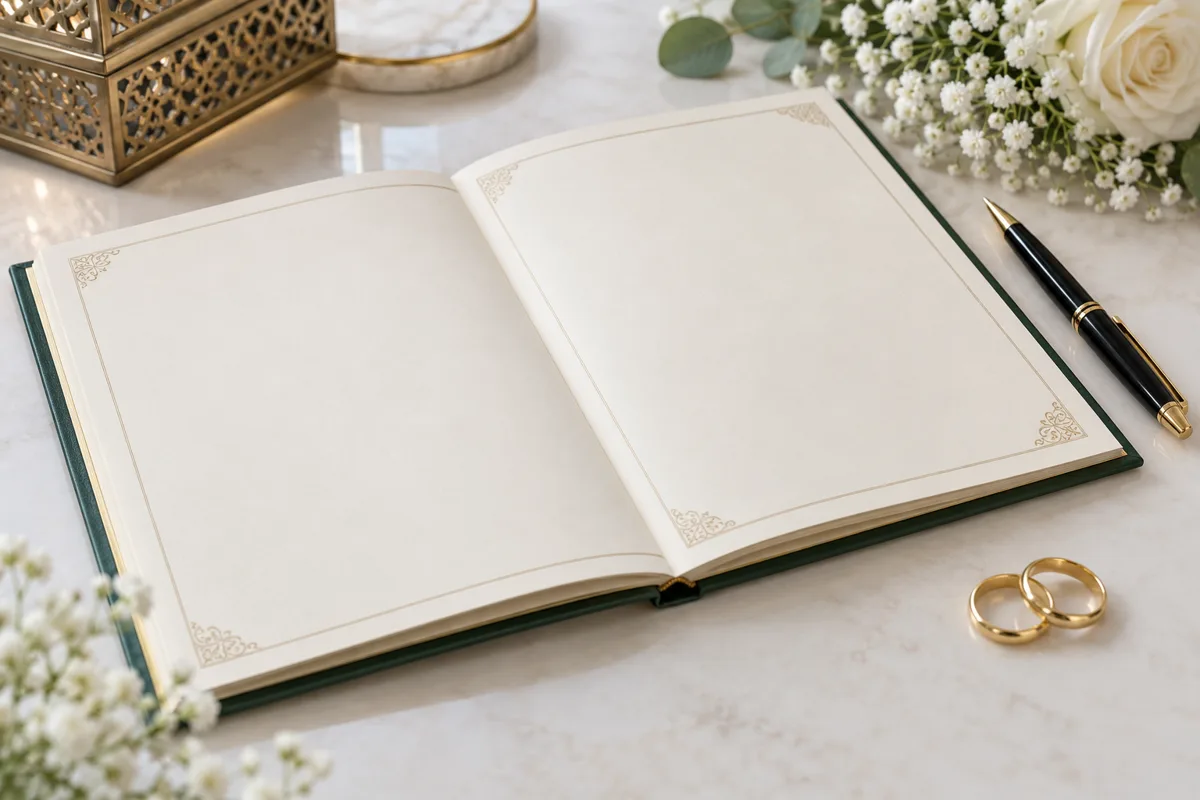
Before the Nikah ceremony, the bride and groom meet with the Nikah Khawan to discuss the terms and conditions of the Nikah Nama. These may include mehr (dower), the responsibilities of the husband, and any specific conditions set by the bride or groom.
The Nikah Khawan explains the bride and groom’s rights and responsibilities as outlined in the Nikah Nama. Both parties need to have a clear understanding of these obligations.
The ceremony involves reciting specific religious verses and declarations in the presence of witnesses. Both the bride and groom and the Nikah Khawan sign the Nikah Nama to make the marriage official.
The Nikah Nama is signed in front of two adult Muslim witnesses, who must also provide their identification details. These witnesses attest to the Nikah’s authenticity and both parties’ consent.
Marriage registration is a legal duty and provides an important official record. A missing registration entry or lost copy is not, by itself, a reliable basis for declaring a marriage invalid. An adviser should review the evidence and explain the appropriate registration, correction or certified-copy procedure.
Once the Nikah Nama is registered, the couple can obtain the official Nikah Nama certificate. This legal document certifies the marriage and is essential for various legal and social purposes.
The Nikah Nama certificate should be carefully preserved. It is often required for visa applications, inheritance claims, and other legal matters. Losing this document can pose significant challenges, so it’s essential to keep it in a safe place.
Our legal team can explain the form, review proposed conditions and assist with the appropriate registration route. For the numbered fields, see our Pakistani Nikah Nama form guide. For subsequent computerised documentation, see NADRA Marriage Certificate guidance.
Confirm the assigned professional, appointment and scope before delivering originals. Fees for legal advice, registrar work, translation and certificate assistance should be distinguished.
Contact Pakistan Marriage Services through the site’s appointment details. Start with the main document and the clauses or correction you need explained. Keep private identity documents out of public comments or unverified messaging channels.
Start with readable identity documents, the proposed service, the relevant city and each applicant’s current location. Send earlier marriage, divorce or death records where applicable. The final checklist depends on the case.
No. Pakistan Marriage provides private legal and documentation assistance. The competent registrar, Union Council or other relevant public authority performs official registration and issues official certificates.
No. Document checking, witness arrangements, registrar availability, record verification and public office working days affect completion. Request an estimate after the file has been reviewed.
Ask for an itemised quotation separating professional work, government charges, translation, attestation and delivery. Obtain receipts for official payments and written confirmation of the agreed scope.
Compare the source identity documents with the marriage record before submission. An existing error should be raised with the issuing authority through its correction procedure; it should not be concealed or informally overwritten.
Access is subject to identity, lawful authority and the issuing office’s rules. A public website or telephone enquiry does not authorise unrestricted access to another person’s personal record.
No. The Nikah Nama is the marriage contract and source record. A computerised Marriage Registration Certificate is issued through the competent local authority after the applicable registration and verification process.
NADRA supplies civil registration technology. The relevant local authority is responsible for the marriage registration record and certificate. A Family Registration Certificate is a separate NADRA document.
The receiving country and institution set their own requirements. They may request a translation, verification, apostille or other legalisation. Confirm the exact checklist before ordering extra services.
Use the contact details on this website and explain your city, location, intended service and any deadline. Request a case-specific checklist and a written quotation before making travel or payment arrangements.
Pakistan Marriage Services provides legal assistance for Court Marriage, Online Nikah, and marriage registration across Pakistan under the legal supervision of Zaheer Ahmed Qazi (Advocate High Court) and the management of Advocate Sobia Mohsin, Family Lawyer.
Karachi Head Office: Qanoon House, Johar Chowrangi, Gulistan-e-Johar, Karachi, Pakistan
Court Marriage | Online Nikah | Nikah Nama | NADRA Marriage Certificate