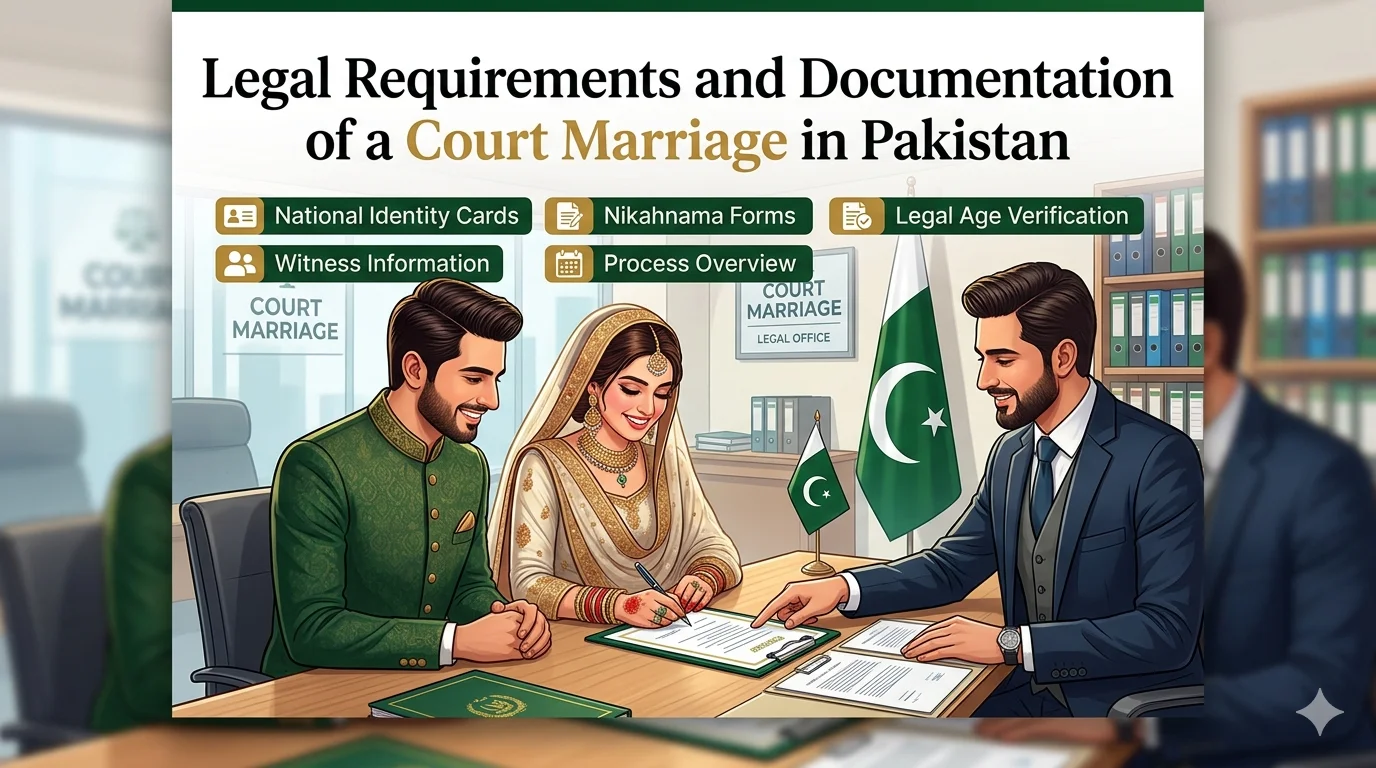

Court marriage in Pakistan is a legally valid Nikah solemnized with free consent, proper documentation, and Union Council registration, ensuring nationwide legal recognition, NADRA record integration, and enforceable marital rights.
Court marriage in Pakistan enables consenting adults to solemnize and register Nikah through lawful procedure, documentation, and Union Council registration, ensuring NADRA-verified marital status, legal protection, and enforceable rights across Pakistan and for international purposes.
Court marriage in Pakistan is a legally recognized method of marriage that allows consenting adults to solemnize and register their Nikah without unnecessary social pressure, procedural delays, or informal practices. Under Pakistani law, court marriage provides full legal protection, official registration, and enforceable marital rights when conducted through proper legal procedure.
Here you will find the eligibility requirements, documents, fees, timelines, and the role of family lawyers in a clear and legally accurate manner of a court marriage.

A properly solemnized and registered court marriage is legally recognized across all provinces and territories of Pakistan. Once entered into Union Council records and uploaded into NADRA’s CRMS system, the marriage becomes legally verifiable for judicial, immigration, inheritance, and civil documentation purposes nationwide.
Court marriage in Pakistan is commonly chosen by couples who seek lawful marriage without social pressure, procedural delays, or informal arrangements that may compromise legal validity.
Marriage with one’s free consent is a fundamental human right. The Constitution of Pakistan guarantees the right of adults to enter into marriage with free will, and Pakistani family laws recognize Nikah as valid once it is properly solemnized and registered.
When these steps are followed, the marriage is legally enforceable and recognized by all authorities.
Court marriage option in Pakistan is available to individuals who meet the following legal criteria:
Court marriage procedure in Pakistan follows a structured legal sequence, designed to ensure validity and transparency.
Step | Description |
Document Verification | CNICs, marital status, and supporting documents are verified |
Consent Affidavits | Sworn affidavits of free will are prepared and attested |
Nikah Solemnisation | Nikah is performed by licensed Nikah Khawan |
Nikah Registration | Two stamped Nikah Nama copies issued by Registrar |
Union Council Entry | Marriage registered for official record |
NADRA CRMS Update | Marriage entered into the NADRA family tree |
This structured approach ensures that the marriage is legally secure, verifiable, and court defensible.
For city-specific procedure and same-day facilitation, see Court Marriage in Karachi – Procedure & Fee

Proper documentation is essential to ensure legally valid Nikah registration and Union Council recording in Pakistan.
Category | Documents |
Bride & Groom | CNIC or B-Form |
Photographs | Six passport-size photos each |
Affidavits | Free will & marital status affidavits |
Witnesses | CNIC copies of two adult witnesses |
Divorced | Divorce certificate |
Widowed | Death certificate of previous spouse |
Embassy NOC is not required for foreign nationals.
Court marriage fee in Pakistan varies depending on city, urgency, and documentation complexity.
Component | Estimated Range |
Legal Services & Drafting | PKR 10,000 – 20,000 |
Nikah Khawan & Registrar | PKR 5,000 – 10,000 |
Notary & Attestation | PKR 2,000 – 5,000 |
NADRA & UC Registration | PKR 3,000 – 5,000 |
Total Estimated Cost: PKR 25,000 – 40,000
Transparent fee structures are essential to avoid hidden charges later.
The Nikah solemnization itself may take 30–60 minutes once documents are complete. However, full legal completion, including Union Council registration and NADRA entry, may take 2-3 working days depending on local administration.
Claims of “instant marriage in minutes” are misleading and should be treated with caution.
The difference between court marriage and traditional marriage lies primarily in legal registration, documentation, and procedural certainty.
Aspect | Court Marriage | Traditional Marriage |
Legal Registration | Mandatory | Sometimes delayed |
Family Consent | Not mandatory | Usually required |
Time | Short | Lengthy |
Cost | Controlled | High |
Documentation | Complete | Often informal |
Court marriage priorities legal certainty over ceremony.
Although court marriage is legally straightforward, professional assistance significantly reduces procedural risk. Legal guidance by family lawyers ensures correct affidavits, lawful Nikah registration, Union Council compliance, and NADRA updates.
For online marriages and overseas cases, family lawyers also coordinate powers of attorney, representation, and registration, ensuring that the marriage remains valid for future legal and immigration use. Experienced family lawyers coordinating documentation and registration are detailed here: Court Marriage in Karachi by Family Lawyers
Court marriage ensures:
Official Union Council registration
NADRA marital status integration
Enforceable spousal rights
Recognised proof for visa and immigration
Protection from coercion or forced marriage
Court-defensible documentation
Unlike informal arrangements, a properly documented court marriage protects both spouses under Pakistani law.

Yes. Court marriage in Pakistan is legally valid when Nikah is solemnized with free consent, properly registered by an authorized Nikah Registrar, and recorded with the relevant Union Council and NADRA system.
No separate statute exists titled “Court Marriage Act.” Court marriage operates under Muslim Family Laws, Nikah registration laws, and Union Council procedures that collectively provide full legal recognition.
No. Court marriage is not performed by a judge. The Nikah is solemnized by a licensed Nikah Khawan and registered through authorized legal and administrative channels.
The minimum legal age for court marriage is 18 years for both bride and groom. Marriages below this age are illegal under Pakistani child marriage laws.
No. Adult individuals may marry free consent without parental approval under Pakistani law.
Court marriage may be conducted discreetly, but legal registration with Union Council and NADRA is mandatory, ensuring official record of marriage.
Nikah solemnization may be completed within an hour once documents are ready. Full legal completion, including Union Council and NADRA registration, usually takes several working days.
Required documents include CNICs or B-Forms, six passport-size photographs of each party, sworn affidavits of free consent, CNIC copies of two witnesses, and divorce or death certificates where applicable.
Yes. At least two adult witnesses meeting legal and religious requirements must be present during Nikah. Witnesses may be relatives.
Yes. Divorced individuals may remarry through court marriage after completion of iddat and submission of valid divorce certificate.
Yes. Widows and widowers may marry upon submission of death certificate of previous spouse and completion of iddat period.
Yes. After Union Council registration, marriage is uploaded to NADRA CRMS system and recorded in family tree of both spouses.
Yes. Overseas Pakistanis may contract court marriage through lawful representation and documentation completed in Pakistan. The Nikah Nama and computerized marriage record process is detailed here: Nadra Computerized Marriage Registration and Nikah Nama
Yes. Online Nikah in Pakistan is legally valid when Nikah is solemnized through a Vakeel, with free consent, properly registered by an authorized Nikah Registrar. Legal requirements for remote solemnization are explained here: Online Nikah in Pakistan
Yes. Foreign nationals may marry Pakistani citizens through court marriage with valid identification and lawful procedure. Embassy NOC is generally not required.
Yes. A properly registered court marriage with Nikah Nama, Union Council certificate, and NADRA record is valid for immigration and embassy purposes.
Nikah is the religious marriage contract, while court marriage refers to lawful facilitation and official registration of Nikah through legal and administrative procedure.
Court marriage may be challenged only on limited grounds such as fraud, coercion, or lack of consent. Proper documentation greatly reduces challenge risk.
Couples choose court marriage for legal certainty, confidentiality, cost control, faster procedure, and protection from social or family pressure.
Yes. Once registered, court marriage is legally recognized across all provinces and territories of Pakistan.
Family lawyers prepare affidavits, coordinate Nikah registration, manage Union Council procedure, and ensure NADRA entry, making marriage legally secure.

Final Note
Court marriage in Pakistan is a legal right, not a loophole. When handled correctly, it provides dignity, protection, and certainty for couples choosing to marry lawfully. Couples seeking confidential court marriage assistance may review Court Marriage in Karachi.
Pakistan Marriage Services provides legal assistance for Court Marriage, Online Nikah, and marriage registration across Pakistan under the legal supervision of Zaheer Ahmed Qazi (Advocate High Court) and the management of Advocate Sobia Mohsin, Family Lawyer.
Karachi Head Office: Qanoon House, Johar Chowrangi, Gulistan-e-Johar, Karachi, Pakistan
Court Marriage | Online Nikah | Nikah Nama | NADRA Marriage Certificate